
Understanding Entity SEO
It is essential to understand the concept of an entity before being aware of entity-based SEO. For SEO purposes, an entity is an object or concept that a search engine can stand on its own. It is not reliant just on a keyword. Rather, Google reads what it was actually saying.
For instance, the term “Amazon” may be used to mean the company, the rainforest, or a river. Now search engines attempt to decipher the intent of the user by taking context and surrounding information into account. This is the place where semantic search can be of help.
Google is not looking for an exact word match, but it’s researching relationships between concepts. Google already knows that Apple isn’t the fruit when it comes to the world’s best smartphones and searches for that term. It is entities and topic relationships that bring that understanding.
Modern algorithms are designed to identify these linkages in a natural manner. They look at the surrounding keywords, user activity, related keywords, and site authority to determine which pages will be more successful in ranking.
The Time of Keyword-Based SEO is Past
In the beginning of SEO, it was much easier to rank a website. A page can obtain multiple times the same term in its headings, paragraphs, and meta tags. At times, the quality of the content wasn’t that important.
Today, it’s very different. User intent and contextual understanding are now a primary concern of Google. The search engine does not look for the number of times the keyword occurs on the page; it tries to determine whether the page really resolves the user’s problem. In today’s modern SEO strategies, businesses are more concerned with questions such as:
- What is the actual subject of the content?
- How do other ideas relate?
- Is the material adequate for the topic?
- Are they certain of the information?
This is where entity SEO can be quite useful. Search engines prefer to see relationships between topics rather than keywords “stuffed” into pages. For instance, if a website is discussing digital marketing, then other concepts associated with it are expected to be there as well. These can include SEO, analytics, content strategy, branding, conversion optimization, social media, and audience targeting.
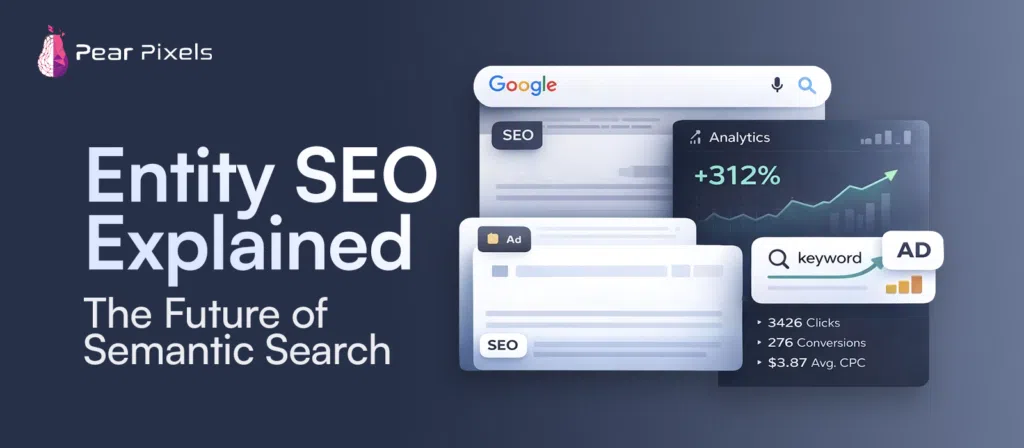
The more these relationships are explicit, the more Google will be able to grasp the content. That is why today’s SEO community is having a semantic search revolution, the talk of which, entity SEO explained: The future of semantic search is a major part.
Google’s Knowledge Graph: A New Dawn
Google’s Knowledge Graph is one of the primary reasons behind the power of entity SEO.
The Knowledge Graph is essentially a huge information storehouse where Google has stored relationships between entities. It aids search engines in comprehending the relationships between people, companies, industries, products, and ideas. For instance, Google can interpret:
- A founder is a member of a business that was created.
- A product is a member of a brand
- A city is a part of a country.
- A technology is connected to an industry
This system allows Google to provide more accurate and meaningful results. This can frequently be found on search results. In some cases, Google presents information panels to celebrities, companies, movies, products, or locations on the search results page. Most of those details are typically derived from relationships between entities in the knowledge graph. This change has caused websites to evolve and require content that tries to communicate a topic rather than just work repetitive keywords over and over.
The Importance of Semantic Search in Today’s Landscape
Search behavior has changed a lot. Users are no longer searching for just short phrases such as “best laptop” or “cheap shoes.” They’re now searching more ‘conversationally’ with detailed questions and via voice search. Some questions that are asked are:
- So, what would be the best laptop for graphic design students?
- What does Technical SEO do to help a website be fast?
- What are some of the advantages of using a semantic search engine in artificial intelligence?
Search engines have to grasp context and meaning, not only exact keywords, to answer these queries correctly. AI and ML also took search engines to a whole new level of intelligence. Google is now able to identify language trends, sentence structures, and user behavior with amazing precision.
That’s why entity SEO has been woven into the future of semantic search. Today’s algorithms will favor websites that develop logical topical connections and valuable information ecosystems.
Topic Clusters and Topical Authority
Making topic clusters is one of the crucial strategies in entity SEO. Websites are not only publishing isolated articles, but connected content ecosystems as well. A central article will be a general article on a general topic, and support articles will provide information about specific subtopics. For instance, a website that discusses SEO may actually have a section on:
- Technical SEO
- Local SEO
- On-page optimization
- Content strategy
- Website speed
- Structured data
- Internal linking
All of these pages are naturally linked together with internal links. This will help the search engines realize that the website is truly an expert in the particular topic. This results in topical authority over time. The website is perceived by Google as a trusted source of information rather than a random page attempting to rank for a keyword.
Many modern SEO pages are now structured in this way because it is more conducive to the creation of semantic signals for search engines. The arrival of structured data and Semantic signals.The emergence of structured data and Semantic signals.
Another Important Aspect of Structured Data is Entity SEO
Schema markup assists search engines in easily seeing important data. It provides Google with information about what a page is. For instance, structured data can be used to recognize:
- Organizations
- Products
- Reviews
- Authors
- Articles
- Events
- Locations
This helps search engines to understand the entities in content more easily. Schema markup gives Google the information it needs if someone talks about a company in an article, and allows it to identify it as a real company rather than just text within a paragraph.
Structured data also helps in increasing the likelihood of obtaining rich snippets in search results. These improved search listings can feature ratings, FAQs, product information, or company information directly on Google. Schema can’t necessarily lead to rankings, but it does certainly help with semantic understanding.
The Quality of the Content is as Important as Ever
Entity SEO isn’t just about technical optimization. The quality of the content plays a role as well. More and more search engines consider expertise, authority, and trustworthiness. Google wants to see content written by people who really know what they are talking about.
Thus, detailed explanations, case studies, real examples, and expert tips have proven more valuable in today’s SEO tactics. When a website regularly releases meaningful, well-structured, and trustworthy content, it tends to do rather well over time. Thin content with weak explanations simply does not work the same way anymore. Today, search engines will reward sites that develop content that really aids users in understanding topics correctly.
The Future of Search Is Semantic
It’s evident that the future of SEO is heading towards semantic understanding. The search engines are getting better and better at interpreting language, relationships, and users’ needs annually. AI systems are now increasingly adept at understanding meaning rather than just keywords.
That means websites need to pay more attention to developing cohesive, helpful, and meaningful contextual content. It’s not just about ranking for one keyword anymore. The aim is to be a reliable source of information in a whole topic area.
This is why Entity SEO Explained: The Future of Semantic Search is one of the most crucial terms in today’s digital marketing. As simple as it can be, entity SEO is quite simple at its core. It’s all about making content that’s logical and answers natural questions and links ideas together. If this happens on a regular basis, the search engines know how to use them, the customers feel more secure, and their visibility is enhanced.