
How Google determines who appears
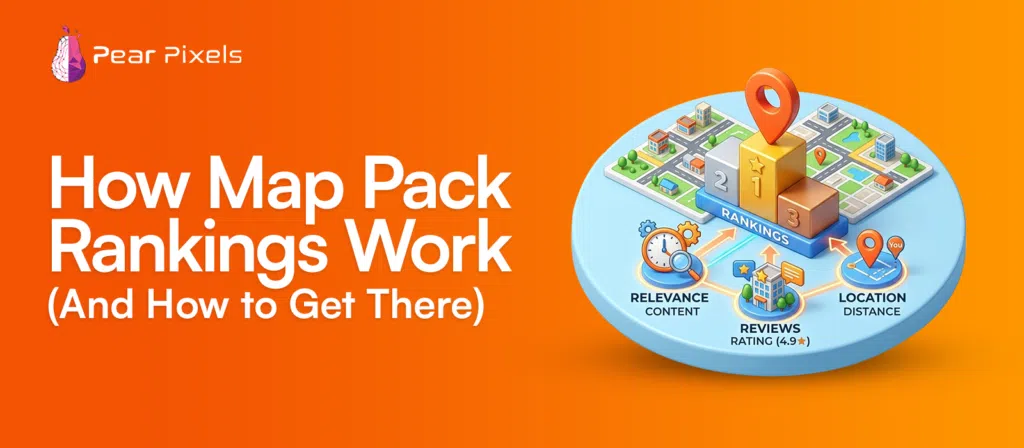
Map pack rankings are mostly controlled by three main elements: relevance, distance and prominence. These are not mere words, but they actually refer to the way your business is judged behind the scenes.
Relevance has to do with how similar your business is to what the person is looking for. This includes your categories, your listed services, and even how your content is written. When your business profile doesn’t explicitly state what you do, Google sort of has a hard time figuring you out.
Distance is more straightforward. This will depend on the proximity of your business to the person looking or the address used in the query. This part is not one that can be really controlled, and attempting to manipulate it seldom works.
Prominence is the strength and dependability of your business online. This encompasses backlinks, reviews, mentions, and general brand presence. The better the business has, the better the signals it will have, and the better the signals it will have, the better the chances will be. The majority of your work is going to be in relevance and prominence. Distance remains the same.
Optimising your Google Business Profile
It all starts with your Google Business Profile. If this is not very strong, nothing else really works as it should. A well-organized profile can be likened to a foundation. One of the most important steps is to select the appropriate category. The main category should be the same as your core service. Going too general diminishes the impact you can have. Secondary categories are helpful but should accompany, not distract from, the main category.
Completeness also is a big factor. The services, products, and the description of those products should portray genuine search behavior. Avoid vague wording. Rather, be straightforward about your activities and scope of work. This clarity allows Google to pair up your business with real user intent.
The details of attributes, opening hours, and service areas may seem small, but it helps to make it all the more understandable. If you fill out your profile correctly, it appears more trustworthy and complete.
One might not think of images as being important, but they are. When you upload it consistently, you will have activity and authenticity. Use real photos of your team, work or location, rather than stock photos. People tend to make judgments based on the first impression.
Posts can be used to bolster your profile as well. These are not direct ranking factors, but they will indicate that your company is alive and well. It’s better to post consistently than to overpost.
The construction of local authority signals
It’s external signals that make things stand out. They’re items not within your profile that can affect your rank. It is important to have uniform information about your business in directories. Your name, address, and phone number should be consistent and identical across all platforms. Small differences can cause a loss of trust signals over time.
It is important to note how beneficial local backlinks are. Local blog or, news sites, or local partnerships provide geographic relevance. These links communicate that your business is part of the real community to Google.
Industry directories are also a factor, but not so much as quality. It’s better to have a few strong listings than a lot of weak ones. Always, the first concern should be accuracy and legitimacy. Your site is another factor. Local SEO pages can help reinforce your local signals. These pages should not be photocopied versions of the other city pages with the names changed.
Examining Reviews as a Ranking and Conversion Factor
One of the most prominent components of the map pack is reviews. They both affect ranking and user decisions. If you have a regular stream of authentic reviews, it means your business is active. If there are long gaps without reviews, it can negatively affect visibility. Google values companies that are continually receiving feedback.
It’s also crucial to respond to reviews. It demonstrates caring and trust-building. If handled properly, even bad reviews can be beneficial. If they are ignored, it raises doubts in the minds of prospective customers.
The quality of the reviews is also a factor. Detailed reviews, describing real experiences, are more effective than short generic reviews. Getting customers to tell their true stories can yield more positive outcomes.
Star ratings are used as a form of instant trust indicator. Many people rate businesses in comparison to others. The smallest of disparities can alter choices. Recent reviews and maintaining a strong rating boost both conversions and ranks.
Factors Your Website Needs to Support Map Pack Rankings
Your website is the backbone of your map pack presence. Google uses it to confirm the information in your business profile. Here, a location page comes in very handy. They assist in linking services to areas. These pages must be based on actual content and real intent. Thin or duplicate pages are not helpful and can even be detrimental to performance.
Internal linking aids in structure. Any services should link to the respective pages and vice versa. Creates a clear connection between what you do and where you do it.
Structured data can also assist search engines in comprehending what your business is about. The LocalBusiness schema helps to validate important information, such as address and contact details. Contact information and maps embedded in the document provide added usability and trust. These little bits add up in ways that people often don’t realize.
Where to Find Map Pack, Performance Data
There’s a slightly unique approach to tracking your progress in the map pack than in conventional SEO. Google Business Profile insights offer some, but not much, data. They are, therefore, only guidelines and should not be considered a definitive measurement.
Call tracking and conversion tracking are much more useful. While getting visibility is great, it’s getting leads and calls that really count. Ranking tools can provide a rough estimate of rank, but results are location sensitive. Rather than pay attention to exact rankings, it is more beneficial to watch trends over time. Business outcomes is the key true objective. Enquiries, calls, and revenue are better indicators of growth than just impressions or clicks.
Wrapping It Up
How Map Pack Rankings Work is not a one-trick pony. It’s about establishing solid signals throughout your profile, your website, and the rest of the internet. If all is set up correctly, you have a better chance of showing up in the map pack. It takes time and persistence, though. Some may say there’s a shortcut, but there isn’t.
Those businesses that make local SEO part of an ongoing strategy have more success in the long run. But small improvements over time make for big results! If you want to grab the local market and convert them to actual customers, then this is definitely the time to concentrate on how map pack rankings work. It isn’t only about being seen, it’s about being there when people are ready to make a decision.