
A Few Second Rule For First Impression
And here is one of the things which still astonishes many users, because in a few seconds they can make their mind up whether they can trust your site or not. It is not even quite conscious. In several seconds, the brain surveys it all: design, spacing, legibility of the text, and even perceived safety.
When I initially tried a version of that homepage, people were abandoning the site almost immediately. It was not the bad service, but the first impression failed to form a connection. It was chilly, somewhat remote.
So I switched the style. I did not all concentrate on structure, but on emotion. Less aggressive visuals, more straightforward headline. And now, suddenly, people lingered. not flawless, but improved. It is here that the psychology related to high-converting websites actually starts, not with tools of design, but with human behavior.
Colors are not Designs, They are Signals
Initially, the colors seem to be a mere flair decision. However, they do imply powerful psychological messages. It is not spoken by people, but they sense it. Indicatively, stress is alleviated by the use of tranquil colors. Urgency is achieved through strong contrast. Dark colors would be luxurious, and light colors would be more approachable. I recall that I only had to change one of the section’s colors on a CTA area, and there was a little more engagement. It was not dramatic, but real.
The main mistake of most sites is that they apply the same mood of color throughout the site. However, in all the sections, users are not always experiencing the same emotion. There must be some sections that help them to relax and some that encourage them to act. It is not very pronounced, yet significant. It’s subtle… but very important.
Too Many Choices Can Quietly Kill Conversions
This is one of the errors I repeat time and again, and it is the notion that having more choices gives you a better experience. It makes sense, but it seldom works in such a manner.
Users are afraid of pressing too many buttons, too many links, and too many directions. And when they balk, they tend to go.
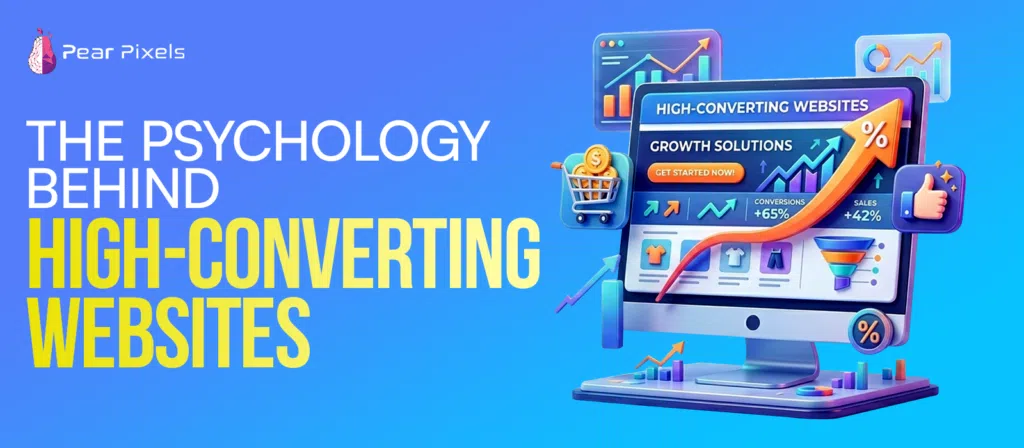
One of the times I cut down a homepage of several service blocks to only three specialised ones. Nothing else changed. But yet, communication was better. This is due to the fact that the brain favors simplicity over complexity. Easy lines are more comfortable. And where it is easy, people get going. It is an extremely important principle in The Psychology Behind High-Converting Websites, although it is usually overlooked.
Reading is Influenced By Words and Fonts
The majority believe that typography is all about style. But it has an influence on the speed at which people read and on their comfort when reading. Users become tired easily when the text is either too tight or too fancy. They do not disappear as quickly when flowing naturally. This is why space, font size, and order are more important than we think.
I began to use more explicit headings, a bit larger body text, and more breathing space between the parts. The content did not change much, but there was an improvement in readability. And readability is enhanced, engagement ensues. This is not magic; this is the way the brain works.
Trust is Built in Small, Quiet Ways
Websites are not so readily trusted. They both have had enough of empty promises, of cliched lines. To build trust has to be done subtly. Not cries of high pitch, but true signals.
Rather than telling the truth that we are the best, it is better to demonstrate. Actual outcomes, actual applications, actual setting. Reliability is achieved through such little details as uniform design and uncluttered structure.
It is also important to put the elements of trust close to the points of decision. The users should be assured that just when they are ready to take action, not in a corner located at the bottom. This is crucial even on SEO pages, where users are already in the process of comparing options.
A Different Attitude is Mobile Behavior
Learning to think like mobile users was one of the things that made me think differently. They are not mere users of smaller screens. They act in a different way. They tend to be distracted and scroll through fast, making hasty judgments. They do not wish to meditate.
Thus, the design must steer them more or less by instinct. Clearly visible buttons, straight line scrolling, and straight line flow of the contents. I recall redesigning a mobile layout through simplifying everything. Fewer words on the screen, increased space, increased touch space. And interaction was made much better. It was like peeling away instead of layering on.
Little Things Make a Lot of Difference
Minor details are more important than we believe. Hover of a button, smooth transition, loading animation- these are little things that make the experience. Users become in control when they receive feedback on their actions. And when they believe that they are in control, they have more trust in the system.
The People Do Not Make a Rational Decision
This was maybe my greatest understanding. We tend to believe that users make a rational choice. However, in fact, it is emotion first. They have a feeling about your site, and then support it with reason.
Thus a high-converting website does not merely tell people how to be, it makes them feel safe, secure, and comprehended. It is more of an emotional than a technical process, attracting curiosity to action. And that is what The Psychology Behind High-Converting Websites is all about.
The Actual Secret is Knowledge of People
Having been working on several designs, one thing emerges very clearly, i.e., the most creative websites are not the best. They are the most humanistic. They do not make too much of an effort to impress. They attempt to reach out.
They know what is in the mind of the user, what may be troubling the user, and what the user needs to feel before making a decision. Such a change in thinking about designing pages to designing experiences alters everything, although it may not be apparent on the surface.
So, What is It That Makes a Site Convert?
It is not only colors, or layout, or content. How all these things combine to fit human psychology is how it works. When a site feels comfortable, straightforward, and credible. people remain. When it seems confusing or daunting. They go. So simple yet not that simple. It requires deliberation, experimentation, and some compassion to do it right. And perhaps this is the entire thing – it is not about building websites, but people.