
A Simple Explanation of MCP
It is helpful to first understand the purpose of MCP in order to better understand MCP Server. The Model Context Protocol serves as a bridge between AI models and the data that they require. MCP provides a standardized and consistent approach for connecting all data sources to all AI tools, rather than developers having to manually do so.
This is significant as enterprise data typically resides in a multitude of systems. Financial data might be stored in ERP, customer support data in a different application completely, and some information in CRM. If there were no way to write a protocol such as MCP, it would take developers a tremendous amount of time to develop an integration on each platform.
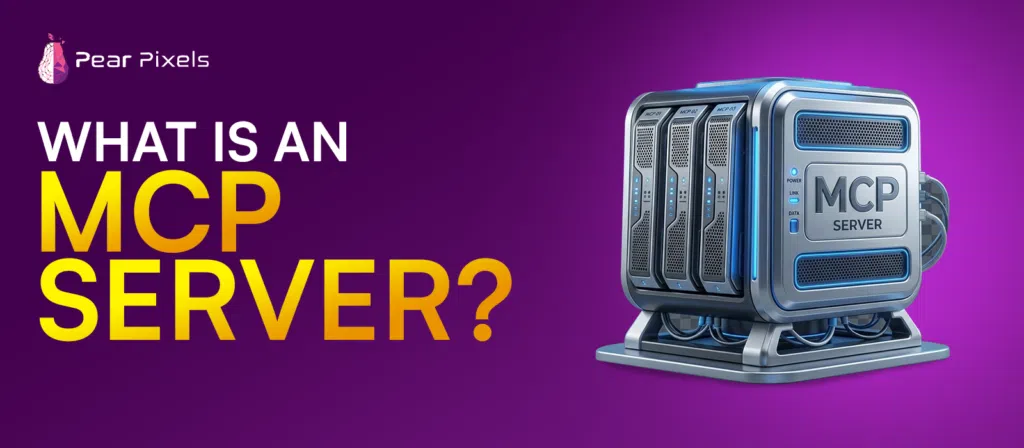
The middle layer is the MCP server that handles these interactions. Intercepts requests from AI applications and interacts with needed back-end systems. The AI app no longer needs to directly access all databases and APIs. The complexity is managed behind the scenes by the MCP server.
This not only improves development times, but also accuracy. With the server supplying relevant and up-to-date information, AI-generated responses are less prone to hallucination or errors. This is quite significant in applications that require accuracy.
Why MCP is Gaining in Importance?
Generative AI is not a cutting-edge, experimental technology. AI tools are already being utilized in various industries, including customer service, healthcare, finance, education, logistics, and more. The more it’s used, the harder it is to keep track of.
All AI systems need context information. If there are no new and organized data, answers can become dated or incorrect. MCP overcomes this issue by enabling standard communication between systems.
Fragmentation of data is one of the biggest challenges that enterprises are currently facing. Data may be spread across various silos, making it hard for AI systems to access the full context. MCP servers make it easy by providing a single point of communication for data.
Scalability is another key thing that makes MCP important. Suppose you have a company that is connecting dozens of software systems and multiple AI applications together. Envision a business connecting dozens of software systems and several AI applications. It would be tedious and costly to meet the need for custom connections for each and every combination. In MCP, this is eliminated by providing one common way to communicate.
Security is also a key consideration. Customers’ or financial information can’t be left unvetted with AI tools. MCP servers add safeguards such as authentication, authorization, masking, and governance policies. This way, organizations can stay compliant with privacy laws while taking advantage of artificial intelligence innovation. Modern businesses focusing on digital transformation and advanced application development services are now considering MCP architecture as an important part of future AI ecosystems.
How an MCP Server Actually Works
On first glance, the technical aspects of an MCP server can seem quite complicated, but the steps taken to create it are quite logical. It all begins with a request from a client application. This client may be a chatbot, an AI assistant, an automation service, or an enterprise application. It contains session context, commands, queries, and user information.
This request is sent to the MCP server, which begins to process the context right away. It verifies the identity of the user, their permissions, and any previous session activity. This allows the server to tailor the responses and provide continuity in interactions. Then, the protocol processing starts. Ruth was one of the smartest things about the system. The MCP server leverages large language models, database schemas, API directories, and metadata catalogs to identify the back-end systems to query.
The server translates the natural language to SQL queries with text-to-SQL mechanisms. In other cases, it could go back to APIs, cloud storage, or a knowledge base. It can even mask sensitive information and send the results back with masking rules. When the backend systems return their responses, the MCP server aggregates and collates the data. Depending on business rules, it may change the format, strip away redundant fields, or anonymize confidential records.
Lastly, the server builds up the response and returns it to the client application. The user gets an immediate response that is relevant to their question without having to see the elaborate dance that is going on behind the scenes.
The Role of Real-Time Data in AI
Real-time AI systems are becoming increasingly prevalent each day, which is a part of why people ask, What is an MCP Server? Expect AI applications to give instant answers, up-to-the-minute recommendations, and context-specific help. Static datasets have become an outdated approach. AI systems that can adapt to the rapidly evolving conditions are essential for businesses. For instance, a financial AI assistant could call for real-time stock data, while a health care assistant might require up-to-date patient details.
This is possible because of MCP servers that seamlessly integrate AI applications with real-time enterprise data sources. This enables the responses to continue to be relevant, accurate, and dynamic.
The server also lowers conversational latency, enabling users to get responses rapidly during conversations. In customer service-driven AI applications, a delayed response time can be harmful to the user experience. MCP architecture helps maintain responsiveness even when dealing with large-scale data operations.
Common Use Cases of MCP Servers
The concept is flexible and has a huge scalability potential, making the MCP servers already applicable in a variety of industries. For healthcare applications, MCP servers can anonymize and securely share medical data, patient information, and disease relationships with AI systems. This enables medical assistants to deliver more context-appropriate and meaningful answers and remain compliant with privacy regulations.
For financial applications, AI typically requires access to market trends, currency exchange rates, transaction history, and fraud detection systems. These interactions are organized and secured efficiently with the help of the MCP servers. Retail firms can integrate their AI assistants with product catalogs, stock management, and customer interactions using the MCP architecture. This enhances the recommendation engines and shopping experience.
Another use case that I can think of is enterprise automation. Business functions can be directly made available to AI tools with MCP servers. An AI assistant can, for instance, start workflows within HR systems, update customer relationship management (CRM) records, or start supply chain operations. MCP servers are also employed by big organizations to integrate multiple data silos. The MCP server eliminates the need for separate communication between AI systems and each individual database.
Security and Compliance Benefits
Security is one of the most compelling arguments in the case of MCP architecture adoption by businesses. AI systems are great, but accessing enterprise data without restrictions can be quite perilous. MCP servers centralize governance and data protection measures. Care is taken to control access carefully with role-based access. In some cases, sensitive data fields can be automatically masked or tokenized prior to sending data to the AI application.
Audit logging is another important feature. Organizations can track those who accessed what data and when. It enhances companies’ visibility, ensuring adherence to regulations and internal governance standards.
Since the communication is centralized on the server, there is less risk of data leakage or unauthorized access to the data that the business faces. This is particularly important in industries that manage sensitive information such as healthcare records, banking data, or legal documents.
The Future of MCP Servers
The direction of AI infrastructure is definitely towards standardized communication systems, and MCP is a key piece of that. The adoption of generative AI technologies will keep growing for businesses, and the requirement for reliable and scalable orchestration of data will only grow.
MCP (Multimedia Content Provider) servers are assisting organizations to minimize complexity and enhance the reliability of AI. Rather than creating isolated systems, companies are able to develop architectures that integrate and communicate securely and intelligently with enterprise environments.
If you’re asked, “What is an MCP server?” the most basic response is that it’s the smart communication layer that enables AI systems to gain access to the appropriate enterprise data securely, rapidly, and precisely.
MCP servers, in many respects, are emerging as one of the cornerstones of corporate AI quietly. Although users might not interact with them directly, these systems are laying the groundwork for the future of AI applications.