
Learning the Concept of GEO
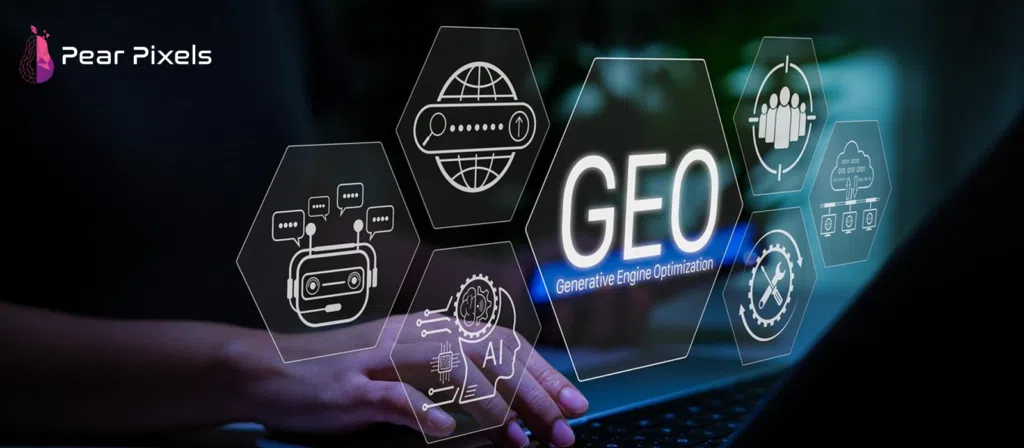
We will make it simple yet somewhat technical. GEO is an acronym of Generative Engine Optimization. It is not merely an empty word; it signifies an entirely new approach to the issue of visibility over the Internet. In the old-fashioned SEO, the purpose was obvious. You write, use keywords, work on your SEO page, and attempt to be ranked higher on Google so people can simply click your link. That was the game.
However, This Time It is Partly Different
Chatbots and other AI engines, such as Google AI Overviews and other generative engines, do not simply display links. They generate answers. They read various sources, grasp context, and then provide a straightforward answer to the user. Instead of ten blue links, the users obtain a single answer.
That’s Where GEO Comes In
Rather than maximizing with the aim of ranking, GEO is about maximizing your brand, your content, and your authority to ensure that AI systems choose you as an authoritative resource when producing answers. So, should someone ask once more, What is GEO, you can tell them it is the answer, not being a link.
The Dislocation Between SEO and GEO is Different
Search used to be clean and simple. You put in a key, you see, you press, that is it. However, as time went by, search engines were cluttered. Advertisements, clips, gadgets, pop-up, etc. it began to weigh on. Then AI brought an alternate experience. Straightforward, no mess. It is more or less like time-travelling but with better technology.
This change did not occur on a single night. It was building slowly. Updates to the algorithm, information flood, user frustration… all of that made room to something new.
No Longer with GEO, the Emphasis is on Keywords. It is Entities.
The entity may be a brand, an individual, a service, or even an idea. The idea is to ensure that AI gets the idea of your entity. When a question of this sort arises, your name appears in the response. It’s a small thing, and yet a huge thing.
Why is search being transformed by AI so rapidly? The AI tools are created to excel at a single task. Give answers. Conventional search engines provide choices. AI gives conclusions. The difference has more to it than it appears.
People are now getting accustomed to typing out complete questions and not just typing down keywords. They want to be placed in context, made clear, and understood fast. And AI delivers that. But yes, it is not perfect. It occasionally makes errors, and sometimes it draws bizarre facts out of thin air. Despite that, it is developing rapidly, and it is not going to disappear.
This is what is starting to make the knowledge of What is GEO vital to marketers, writers, and businesses. Since the question being answered is by AI, your content must be included in that answer.
Do We Still Need Google or Not?
Short answer, yes. Very much. Despite all this AI hype, billions of searches are conducted on Google every day. The figures are nowhere even when it comes to AI tools. It would be a mistake to ignore SEO. However, and conversely, it is dangerous not to pay attention to GEO.
The behavior of users is changing gradually. Others still desire to navigate through links, and others just want to have some quick answers. And that is where business has to change. It is not about making a decision between the two. It is a matter of knowing both.
How GEO and SEO are Alike and Yet Different
SEO and GEO are not enemies. They resemble two faces of the same coin. SEO is about presence in search engines. You streamline content, construct backlinks, enhance organization, and seek clicks.
GEO prioritizes perception within responses generated by AI. You maximize meaning, authority and context to ensure that AI systems have confidence in what you are offering. One brings traffic. The other brings influence.
Another, not the least, interesting fact in this case is that the GEO traffic may be smaller, but it is frequently more valuable. Already, there is a context of users who come through AI answers. They are better prepared to act. Instead of merely counting clicks, the emphasis is on quality.
The Emergence of the Zero Click Experience
Everyone was very scared of the notion that people would cease to click on websites. And somehow that is happening. Direct search answers or AI-based solutions give answers to the people. Sometimes no need to go to a website.
This is not to say that your brand is not visible. It only means that your position is different. Traffic is no longer the sole measuring rod of your success. Presence, authority, and frequency of your brand appearing in answers are also measures.
Here, GEO Comes to Play
Users do not need to be clicked on, they will still see your name. And that develops trust in the long run, although not in the short. Measuring GEO is a bit tricky. SEO has clear metrics. Rankings, traffic, bounces, conversions, all can be tracked. Measurement is not that simple with GEO, as it is still new.
No one dashboard informs you of how many times AI has talked about your brand. And gradually, instruments are appearing. Marketers are trying out new approaches. They monitor brand mentions, monitor search trends, and monitor how the content performs across platforms. It is not ideal, but it is in the process of development. And frankly, such confusion is common. This is the stage of every new technology.
What Comes Next in this New Search World
So where are we heading? Search appears to have a hybrid future. Traditional SEO will stay. GEO will grow. AI will become more accurate. The users will be increasingly demanding. Content will have to be more meaningful and not only optimized.
The brands will have to pay attention to authority, clarity, and trust. The reason is that AI systems like to use credible sources. And the question ‘What is GEO will gradually become a question in a different direction… What it is like to approach GEO in an effective way. That is where strategies will develop. The construction of content, the depth of semantics, and entity construction, all of these will have more significance.
A Simple Way to Think About It
.
GEO is being chosen whilst SEO is being found. Where SEO introduces you into the list, GEO introduces you into the answer. And in a world where users demand to get quick and direct answers, it is nice to be the answer, so to speak. Then be it you are running a blog, a brand, or creating anything to fill an SEO page, GEO is no longer an option. It is gradually taking root in the foundation. And yes, it is probably unstable at the moment; it is a bit of a mess, but that is how any transformation of such scale begins.